
Oakton Previous Residents by Era
An Oakton address has several possible historical trails. Deeds establish transfers and legal descriptions. Tax books offer tract and timing clues. Directories may give a period address-to-name lead, while a census gives a dated household checkpoint. Permit systems describe changes to a site, not a list of people. Start with the source closest to the period you need, then use another record with the same tract, street form, or person identifier to test it.
| Source | Years | Where Held | What Shows |
|---|---|---|---|
| Fairfax deed images and indexes | Images 1742–present; HRC originals 1742–1942 | Land Records Research Room, CPAN, HRC, Library of Virginia microfilm | Grantor, grantee, legal description, book/page, and prior deed references |
| Fairfax real-estate tax books | 1851–1980 | HRC and Library of Virginia | Taxpayer, tract, building, assessment, and timing clues |
| Personal-property tax books | Through 1919 | HRC and Library of Virginia | Historical household and property clues within the series |
| Hill’s Arlington County Criss Cross | 1955–1976 reported run | Virginia Room local collection report | Regional address-to-name or telephone lead, not every Oakton year |
| Virginia city directories | 1873–1960 statewide description; William & Mary 1801–1929 | Virginia Room and university collections | Possible name, address, occupation, spouse, telephone, or organization notation |
| Federal census | 1950 is the latest public full census by September 2026 | National Archives and digitized genealogy services | Dated household checkpoint, not annual occupancy |
| PLUS and LDIH | PLUS after October 31, 2022; LDIH older history toward early 1980s | Fairfax public portals | Permit, site, or application chronology |
| Sanborn maps | Generally about 1885 through the 1960s; Oakton sheets unverified | Library and map collections | Possible building and street context |
| Obituaries and probate | Date varies by source and file | Virginia Room, Fairfax Probate, HRC, Library of Virginia | Death, heir, and prior-address leads requiring identity checks |
Do not treat a row as a guarantee that the exact address is present. Fairfax is the county custodian for Oakton records, and directory, deed, and map coverage can differ even for the same time period. The strongest account of past residents preserves the source name, date range, record reference, and what was actually found.
Oakton Address Records Need MAR
Before following previous residents, normalize the address in Fairfax County’s Master Address Repository, or MAR. It can return the current or historical address form, parcel PIN, subdivision, ZIP, district, and created or expired dates. This is the evidence tool for an address that may have changed form. No verified Oakton street-renumbering date was found, so do not invent one. Use MAR’s current, historical, and all-status options to build an evidence timeline instead.
Then cross-check the parcel in iCare and Jade GIS. iCare may show an assessed owner, mailing address, situs address, legal description, sales information, and deed book/page reference. The mailing and situs fields are different. A mailing line can be an office, another address, or another locality, and it does not prove who was present at the Oakton parcel. Jade and MAR are map and address tools; the deed remains the stronger title source.
The Fairfax Land Records FAQ is the source shown below; use MAR separately to document the address, parcel, street, status, and date modes that bridge an older street form with the current parcel.
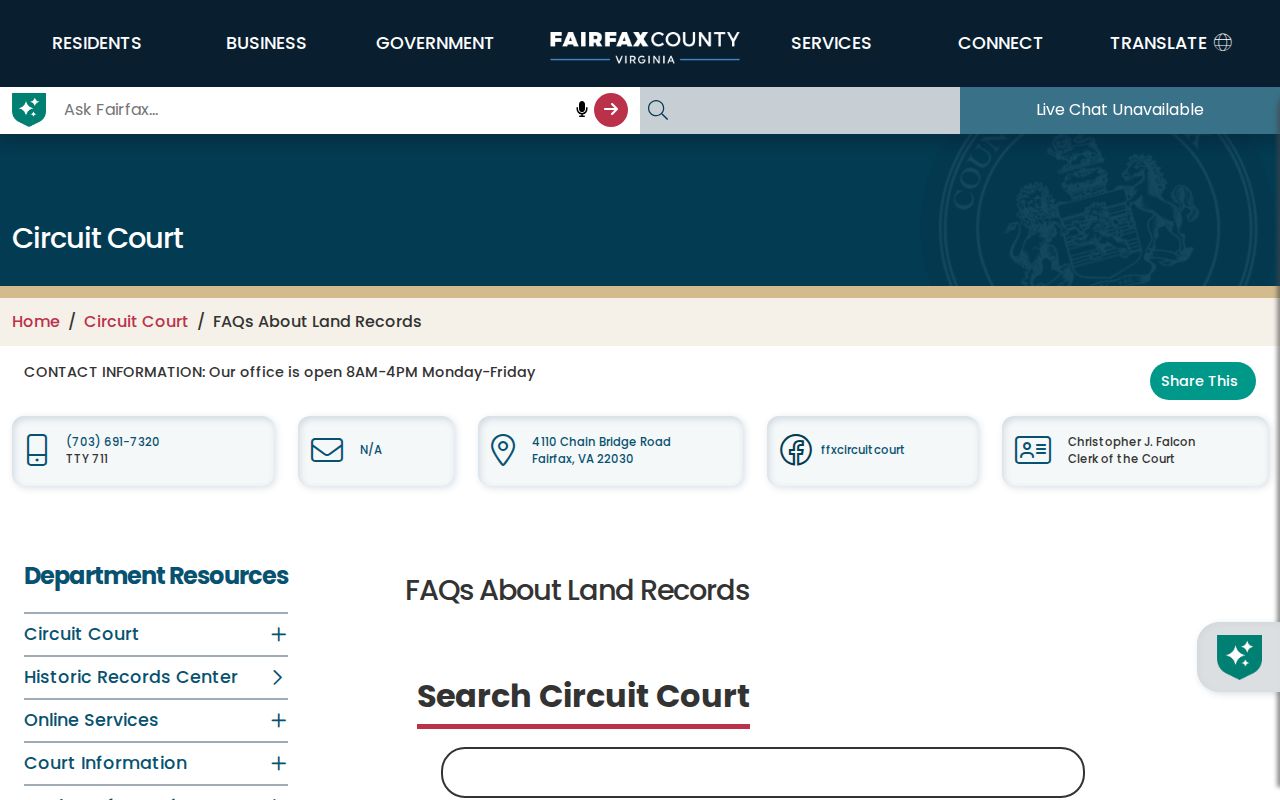
The land-record guidance reinforces the order of work: establish the parcel and deed lead before treating a name as part of an Oakton address history.
Oakton Previous Residents Deed Chain
Ownership is not the same thing as occupancy, but a title trail is the stable backbone for an address history. Begin with the current iCare parcel record and record the legal description and deed book/page. Find the purchase instrument in Fairfax Circuit Court Land Records, identify the seller, and then search that seller as a prior grantee. Continue backward while matching the legal description, lot or tract, and adjoining parcels. A street number may shift while the tract continues.
- Use iCare to capture the current parcel PIN, legal description, and deed book/page.
- Locate the purchase deed in Land Records, CPAN, or the third-floor Research Room.
- Record the named seller and search that seller as a grantee for the earlier purchase.
- Follow every prior book/page reference, including language after “AND BEING.”
- Match the lot, tract, plat, acreage, and neighboring parcels before extending the chain.
- Use MAR historical statuses and tax maps when the street address differs from the deed.
- Grantor
- The party transferring an interest in the instrument.
- Grantee
- The party receiving that interest; searching a later seller as a grantee can reveal an earlier purchase.
- Chain of title
- The linked sequence of recorded transfers for the same tract or legal description.
- Legal description
- The lot, tract, subdivision, plat, or other recorded land description that often survives an address change.
Oakton Land Records Access
Fairfax Land Records documents run from 1742 to the present, but access is layered. Public deed images can be researched at the third-floor Research Room. CPAN provides subscriber internet access, and the Historic Records Center keeps original deed books from 1742–1942. Where an index or image range does not answer the question, HRC, Library of Virginia microfilm, and the courthouse terminal are the documented fallback path.
For a copy request, provide an instrument number or a deed book/page. Certified copies cost $2 per document plus $0.50 per page. The copy service accepts a written request or form with payment and a self-addressed stamped envelope; personal checks are not accepted. The research states mailed copies are normally sent within two weeks. Check the current court instructions before ordering because procedures can change.
Read the Historic Records Center deed research guidance before using an older book. It explains the HRC range and the historical research setting.
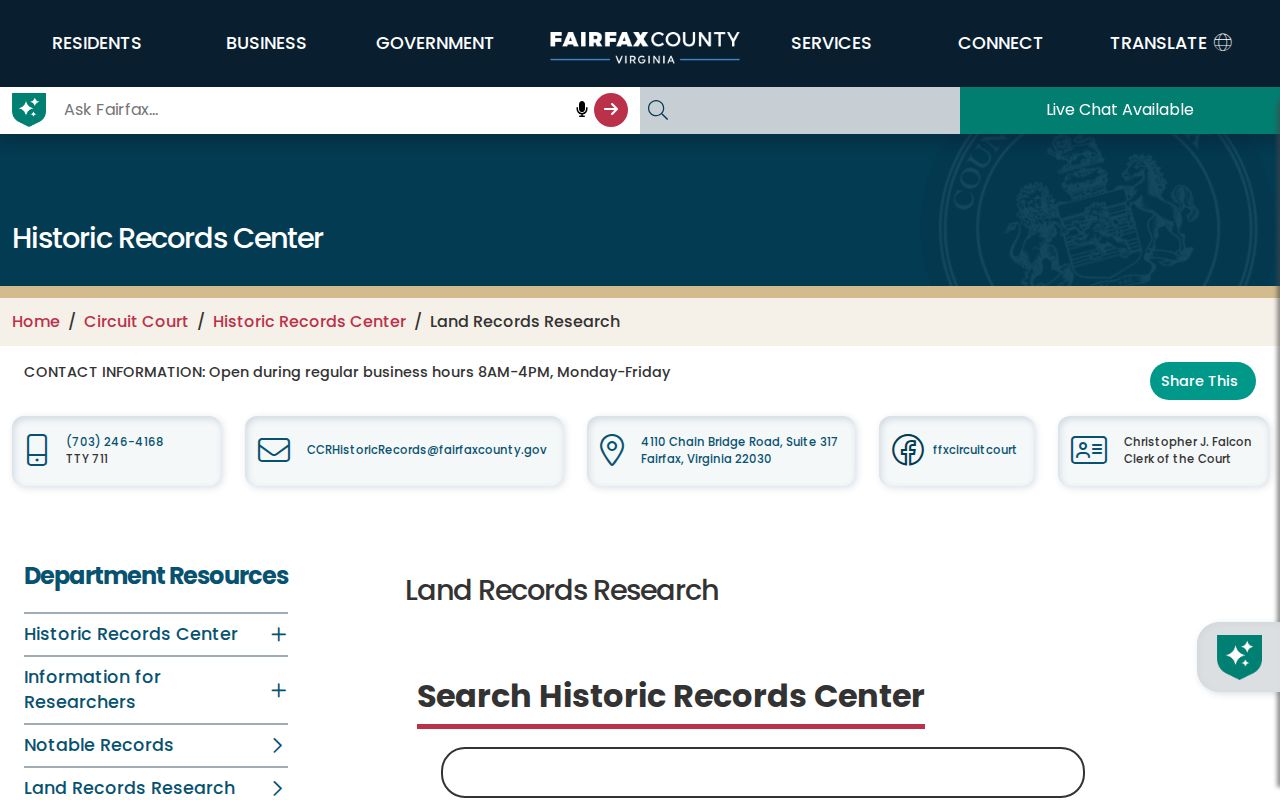
The HRC research page helps connect an Oakton parcel’s book/page lead to original historical deed books when a modern index alone is insufficient.
Oakton Deed Records and AND BEING
“AND BEING” can point from a current instrument to an earlier deed, but it can also defeat a simple name search. Read the referenced book and page, inspect the image and signature page, and record every party role. Additional grantors can appear in the prior-reference language or be indexed differently. Easements may reverse the expected grantor and grantee direction, so the legal description and instrument type matter.
Keep a short chain log as you work: instrument reference, date, party names as printed, party role, tract description, and the exact reason the next link belongs to the same property. That log makes it possible to revisit a difficult gap without confusing two similar names or two adjacent lots. It is more reliable than a narrative built from a single surname hit.
Title caution. A map or assessment report is a locator; the recorded instrument, plat, release, trust, or court order provides the stronger ownership evidence.
Oakton Previous Residents and Census
Past owners are only one part of an address story. For dated household leads, pair a confirmed directory year with the nearest available federal census. The public release rule is 72 years, making 1950 the latest full census generally available by September 2026. A census is a checkpoint, not an annual occupancy record, and a regional criss-cross directory is only a lead until its geographic coverage and page are inspected.
- Start with the address, person, or year already supported by a deed, tax book, or directory citation.
- Identify the specific directory volume and page, then retain the street spelling and number it uses.
- Choose the census release that fits the period and compare household details with that dated address evidence.
- Resolve a mismatch through the legal description, a tax-map clue, an obituary, or another exact identifier.
- Label the result by its year so a past-resident lead is never presented as a current fact.
The Oakton Directory Book explains the collections themselves, including the unverified Oakton local run. For this address-focused trail, use an actual directory entry only after confirming its title, date, page, and place coverage.
Oakton Probate Record Endpoints
When a person disappears from a deed or directory trail, Fairfax probate records may offer a later endpoint. Fairfax Circuit Court’s Probate Division is in Suite 401. Will Books, inventories, accounts, fiduciary bonds, and related chancery material can be separate records rather than one complete packet. If there was no will, an administrator or inventory trail may still be relevant. Match the decedent, county, dates, and tract before joining a probate record to an Oakton address.
HRC has Will Book indexes for 1742–1936, while later material should be checked with Probate or CPAN. The HRC holdings page and its researcher handout differ slightly on the outer endpoint for original Will Books, with the handout describing originals through 1965. Verify the particular volume with staff instead of turning either description into a blanket rule.
Consult the Fairfax will-record guidance for the distinct Will Book, inventory, account, bond, and chancery routes.
The wills guidance shows why one person may leave evidence in several probate series, each needing its own date and record reference.
For an appointment or estate-administration question, the Fairfax Probate administration page identifies the current court route.
The probate administration information provides the official path for estate records that may help date a prior Oakton connection.
Oakton Tax Records in Preservation
Fairfax real-estate tax books cover 1851–1980, and personal-property tax books continue through 1919. They can add a taxpayer, tract, building, assessment, or timing clue to a previous-residents trail. On June 24, 2025, Fairfax Circuit Court announced a $21,450.60 grant to preserve the 1879 Atlas of Fairfax County and the 1892, 1900, and 1910 Land Tax Books. A relevant book may therefore be in preservation or appear differently than an older index suggests.
Use tax material to test a tract over time, not to assume a complete household. Combine it with a legal description, deed reference, map, or probate identifier. The 1860 owner maps can offer another tract lead, but an owner name must be matched against the parcel, tax district, deed chain, and historical place before it is connected to the address.
See the Circuit Court copy instructions for the documented copy route when a specific instrument or book/page is known.
The copy page supports a precise request with a known instrument or book/page rather than a broad request for every record connected to an Oakton address.
Oakton Address Record Gaps
Sanborn guidance for Fairfax describes general coverage from about 1885 through the 1960s, but no exact Oakton sheet or year was verified. Treat that as a gap. The same restraint applies to a directory or deed search that produces no result. Civil War losses affected original wills, deeds, loose papers, many 1763–1819 deed books, and pre-war minute books. A missing item may reflect the series, date range, or survival of the record, not the absence of a past resident or transfer.
Write the result narrowly: “not found in the inspected index,” “series does not cover the date,” “record is restricted,” or “record may be missing.” Include the series, dates, index volume, and repository checked. Then test a separate route such as tax books, an owner map, chancery, a neighboring tract, or a newspaper. That preserves uncertainty while still moving the Oakton address history forward.
Lawful house-history use. Use these records for family history, estate matters, and place research, never to track, contact, or harass a living person.